Coffee and a place to meet
A welcoming café and informal seating, with an experienced food operator and a limited menu that suits the space.
LOCAL ENTERPRISE & EVERYDAY LIFE
A stronger local economy gives people more reasons to work, meet, shop and enjoy themselves here. A downtown entrepreneur commons, better business choices and a more dependable evening scene are three practical ways to explore that opportunity.
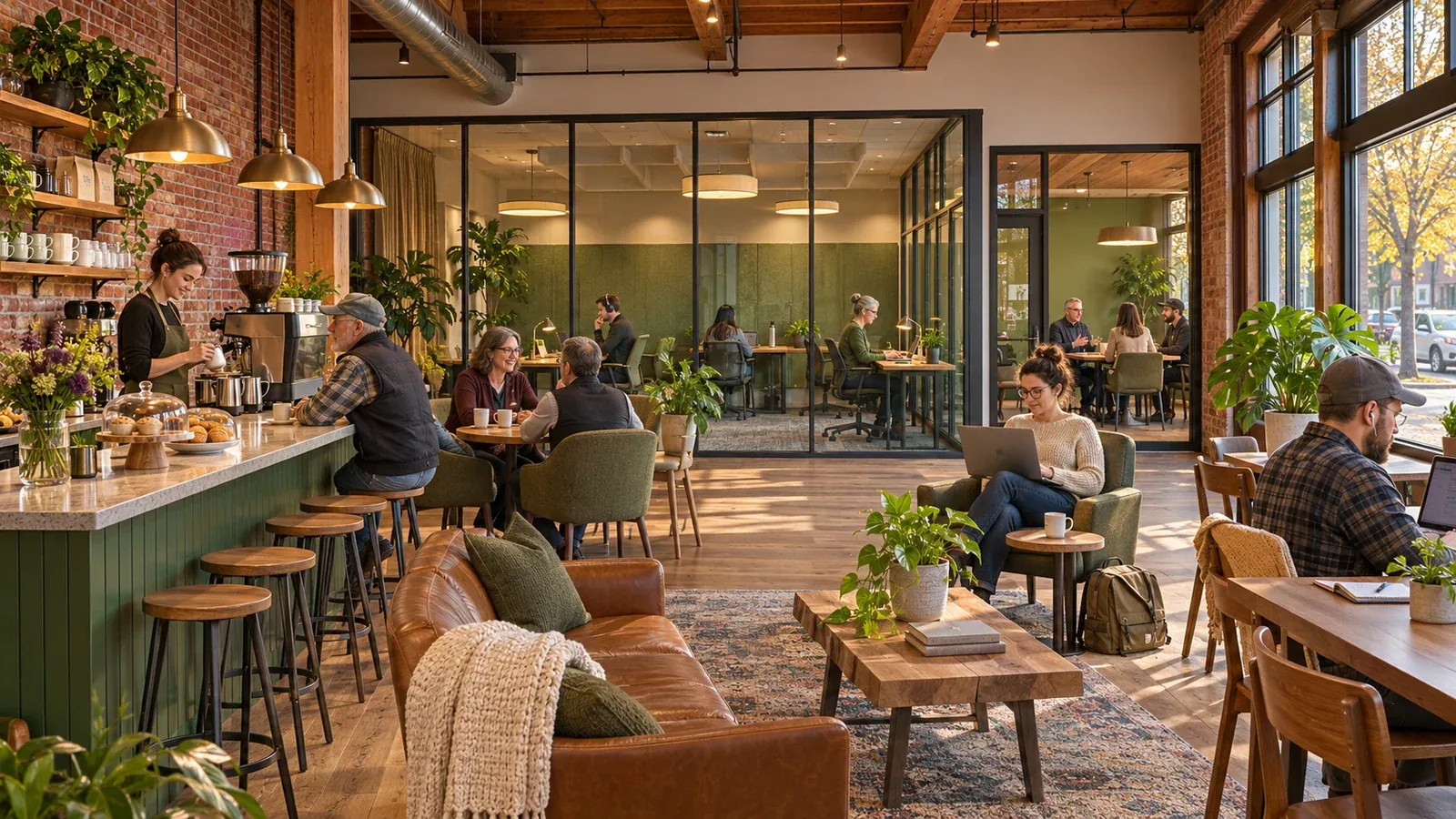 Illustrative concept · No property selected or approved
DOWNTOWN ENTREPRENEUR COMMONS · WORKING CONCEPT
A good business center should be easy to enter and useful on an ordinary Tuesday. Get a coffee. Work for a few hours. Study somewhere quiet. Meet a client. Find someone who can help you turn a promising idea into a business with paying customers.
The proposal combines a public café, flexible workspace and a funded entrepreneur program. It would serve students, remote workers, freelancers, trades and service businesses, and people building companies that can sell beyond the region.
A welcoming café and informal seating, with an experienced food operator and a limited menu that suits the space.
Reliable internet, power, comfortable desks, day passes and monthly options. Separate quiet rooms from the coffee bar, calls and networking.
Bookable meeting rooms, call booths, a workshop room and a modest recording or product-photo studio. Reserve affordable or sponsored study access in the operating plan.
A coordinator, scheduled mentoring and a defined cohort program: customer research, pricing, bookkeeping, early sales and preparation for appropriate financing.
Investigate suitable premises in and around the D1 Jackson–Main district and nearby Washington Street. Prioritize a visible entrance, comfortable walking connections, transit access, bike parking and practical car parking. Proximity to existing advisors, shops and restaurants could help a work visit turn into several local stops.
D1 is a district for investigation. No owner agreement, available building, capacity assessment or approved conversion is implied. Historic review, fire safety, accessibility, acoustics and renovation costs need building-specific answers.
This illustrative allocation shows the mix of uses. It is a planning allowance, not a measured layout, occupancy approval or construction design.
| Proposed use | Square feet |
|---|---|
| Public café and casual meeting space | 1,800 |
| Acoustically separated quiet work and study | 1,800 |
| Dedicated desks and small-team workspace | 1,400 |
| Six small private offices | 900 |
| Divisible classroom, meeting and event space | 1,000 |
| Two call booths | 150 |
| Recording and product-photo studio | 350 |
| Advising and mentor room | 300 |
| Restrooms, circulation, storage and service areas | 2,300 |
| Total illustrative space | 10,000 |
Roseburg already has business advising, office rentals, coworking and pitch events. The gap to test is a convenient combination of walk-in access, quiet study, useful meeting space and a regular community program. A partnership or expansion of an existing operation may be the best way to deliver it.
522 SE Washington Avenue
Office rentals, conference space and a boardroom. Investigate collaboration or a pilot in suitable existing space before duplicating its office-rental role.
Read the current offer729 SE Jackson Street
No-cost business advising, plus classes and training for startups and established firms; course fees vary. A proposed hub could connect people to this existing support.
Read the current offerDowntown · former Umpqua Hotel on Oak Street
Its published offer includes monthly coworking in a 1,600 sq ft space. Hourly and daily use are not offered on the page reviewed; convenient short visits are one service to test.
Read the current offerProduced by Umpqua Economic Development Partnership
An existing pitch-event program for the startup community. The 2026 season has ended; its website says the 2027 schedule is pending.
Read the current offerSources reviewed November 9, 2026. Participation by these organizations is proposed; no partnership or availability has been confirmed. UCC’s current locations page also identifies its downtown SBDC address.
TEST A SMALLER START
Use roughly 1,500–3,000 sq ft of suitable existing space, or work with an existing operator. Run a 90–180-day pilot with day passes, bookable rooms, a weekly founder coffee gathering and scheduled advising or workshops. Test selected evenings and weekends against actual attendance.
A café concession or local coffee partner can be assessed alongside the workspace. The entrepreneur program needs a named coordinator and funded delivery; a room full of desks alone does not establish an incubator.
Prepare a property-specific fit-out estimate and monthly cash-flow plan. This concept has no committed funding, advertised membership price or opening date.
THE SPENDING OPPORTUNITY
When residents travel for a product, meal or activity they cannot find locally, another community receives that sale. Better local choices could keep more of that business here. The useful question is which purchases we can realistically bring back.
A DOCUMENTED RETAIL BASELINE
$1.168 billionThe Census reports $1,167,995,000 in sales at retail establishments within the city. That total can include customers from outside Roseburg. It measures sales, not city revenue, profit or residents’ own purchases.
Read the Census recordA regional shopping center can attract spending and still lose particular purchases to Eugene, Medford, other destinations or online retailers. We have not established a current region-wide dollar loss or the share of residents who leave for major shopping.
Research should distinguish an unavailable product from a price difference, a special outing, inconvenient hours or a trip combined with work, family visits or medical care. Each reason suggests a different response.
Compare the proposed shops and servicesOregon has no general sales tax. A dollar spent in Eugene or Medford does not automatically become a dollar transferred from Roseburg’s budget. Local business activity can support employment, occupied premises and investment; public-revenue effects depend on the actual taxes, fees and jurisdictions involved.
Shopping destinations do not determine legislative seats. Oregon’s districting rules include equal population and other geographic and community criteria. The case for a stronger regional voice should focus on representation and cooperation between governments, alongside the separate economic case for better local choices.
The City’s January 2010 newsletter discussed shopping at Costco locations in Eugene and Medford when explaining the value of bringing Costco to Roseburg. Its $40 million leakage reference was made before the local warehouse opened, and the passage does not provide a transparent calculation or explicit period. It cannot serve as today’s annual loss estimate.
The February 2011 Downtown Grocery Market Study estimated a roughly $6.3 million grocery gap in its downtown market, while the wider ten-mile convenience market was roughly balanced, with a small estimated surplus. A downtown gap can reflect purchases at other local stores. Those older figures do not measure current spending leaving the whole region.
A SCENARIO YOU CAN TEST
Use this simple scenario to explore the relationship between household spending and the share new local options might retain. The example is deliberately separate from the documented Census figure and from any future market study.
These are example assumptions, not measured Roseburg spending or a forecast. Change them to see how the result moves.
Use households, not individual residents. The default is an example, not a Census count.
Physical shops, restaurants and paid family activities. Exclude online purchases, fuel, lodging and medical costs.
A separate assumption. Better options will not replace every trip.
10,000 assumed households × $200 per month × 12 months
At your assumed 25% recapture rate
These amounts are business sales. They are not city tax revenue, business profit, wages or a net economic-impact estimate.
For this discussion, “out of region” means outside the selected inland study region. Trips to included surrounding communities remain local to that region. See the boundary and its limits. The calculator does not count incoming shoppers or measure a net regional trade balance.
This calculator runs in your browser. Its inputs are not submitted or stored as questionnaire responses.
TURN THE QUESTION INTO EVIDENCE
The community questionnaire now includes an optional range for household spending outside the study region during the last 30 days. Together with destination and business requests, it can identify patterns worth investigating.
Voluntary responses cannot establish how most residents behave. A credible regional estimate needs a defined geography, a matched household count, a sound sampling approach and validation against current sales or market data.
Use interviews, a structured household study and category-level analysis before making recruitment or investment claims. No generic multiplier or jobs conversion is applied here.
AFTER WORK, AFTER CLASS, AFTER DINNER
Coffee with a friend. A few shops still open. Dinner, a workshop, music or something to do with the kids. A useful evening scene needs dependable choices within a comfortable walk of one another.
Roseburg already has businesses and events that bring people out in the evening. The opportunity is to connect those efforts and test a more predictable schedule with willing operators. The entrepreneur commons could host a workshop or early networking session that leads into dinner and other downtown visits.
Some tasting rooms close at 5 p.m.; other venues advertise later hours. Limited opening hours may leave some demand unmet, but this sample does not prove why a business closes or whether extending its hours would be profitable.
A small, dated sample of first-party websites, not a census of businesses. Schedules can change by season, holiday or event. Confirm directly before a visit; venue hours do not necessarily establish kitchen or tasting cutoffs.
Daily, 11 a.m.–5 p.m.
Regular tasting-room hours.Check the business’s current hoursMonday–Saturday, 10 a.m.–5 p.m.
Only the listed days are represented here.Check the business’s current hoursDaily, 11 a.m.–6 p.m.
Published schedule excludes certain holidays; confirm seasonal changes.Check the business’s current hoursMonday–Thursday, noon–8 p.m.; Friday–Saturday, noon–9 p.m.; Sunday closed.
Venue hours. Food-truck service may differ.Check the business’s current hoursMonday–Thursday, 4:30–9 p.m.; Friday–Saturday, 4:30–10 p.m.; Sunday closed.
Published restaurant hours; a separate last-order time was not verified.Check the business’s current hoursA participating merchant’s July 2026 announcement described coordinated downtown opening from 5–8 p.m., with shops, restaurants, wineries, music and pop-ups. A regular pilot can learn from the organizers and businesses already doing this work.
Music on the Half Shell brings summer concerts to Stewart Park on Tuesday evenings at 7 p.m. Seasonal events are a foundation for testing how visitors find food, shops and other activities before or afterward.
A PROPOSED 8–12-WEEK PILOT
Start with one evening a week in a compact downtown area. A participating mix could include coffee or dessert, dinner, a few shops, an arts or family activity and a place to work or meet.
Choose the day and hours with operators. Publish one reliable guide showing opening times, food-service cutoffs, age restrictions, accessibility, parking and transport. Include alcohol-free and family-friendly options.
Continue or expand only where the results support it. No business is represented as having agreed to extend its hours.
A DATED RECORD, OPEN TO CORRECTION
The sources support the existing resources, published schedules, historical records and public rules described here. Proposed space, pilot durations and calculator inputs are planning choices, not commitments or measured demand.