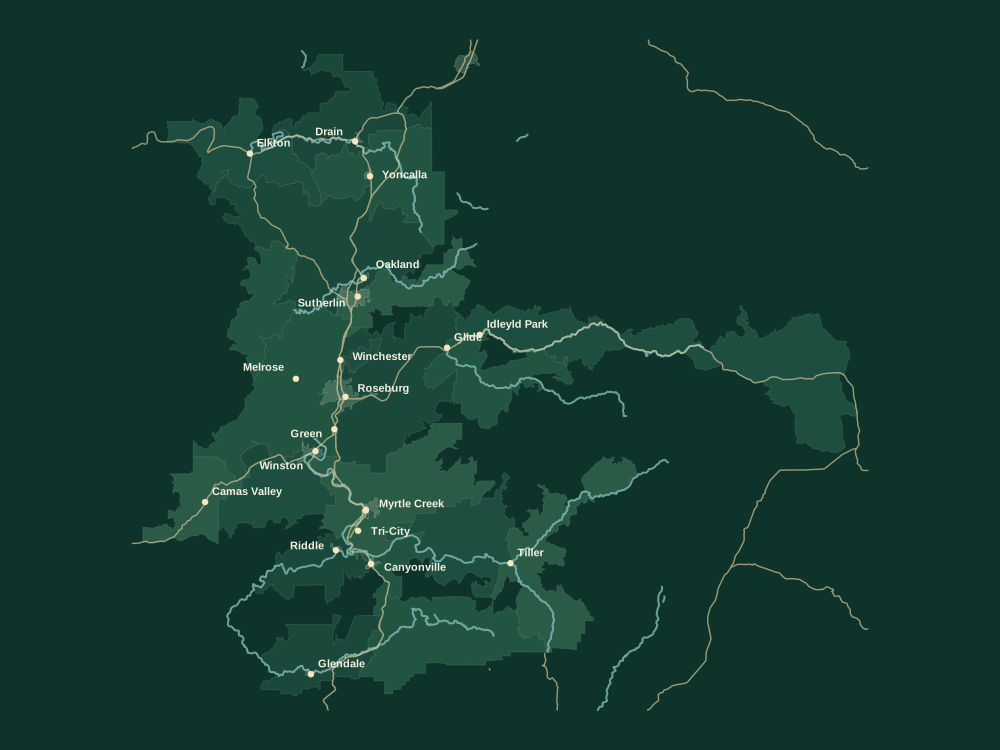
Roseburg’s regional role extends beyond its city limits.
Green, Winchester, Drain, Yoncalla, Myrtle Creek, Tri-City and the surrounding communities have a stake in Roseburg’s jobs, shopping and services. A regional plan should account for those connections, support local improvements and give each community a defined role in shared decisions.
23,683Residents inside Roseburg2020 Census · incorporated city
104,511Residents in the selected study region2020 Census · 23 nonoverlapping Census ZIP areas
One regionMany communities with a stake in its futureA proposal for shared planning and a stronger voice
WHY THE WIDER VIEW MATTERS
The municipal count describes one boundary.
Roseburg serves households in Green, Winchester and the surrounding valleys, as well as people traveling from Drain, Yoncalla, Sutherlin, Oakland, Winston, Dillard, Myrtle Creek, Tri-City, Riddle and Canyonville. The frequency and purpose of those trips differ. They need to be measured when planning businesses, roads and shared services.
This initiative uses 23 nonoverlapping Census areas across inland Douglas County to make the wider population visible. Together they contained 104,511 residents in 2020, including Roseburg’s city population. The geography and source counts are published so the boundary and calculation can be inspected.
The wider perspective changes the questions a plan must answer: where customers originate, which trips need better connections, what each community already contributes and which services should be closer to home. Questionnaire responses can help identify patterns. Business and service decisions also require independent evidence about travel, spending and operating costs.
Use the wider geography to improve specific decisions.
A regional approach changes how customer demand, transport, recreation and service costs are assessed. The purpose is to identify the needs of each community and establish which investments should be coordinated.
Measure customers across the region.
A grocery store, gym or family center needs to understand the households that could realistically use it. Research should include surrounding communities, their travel habits and their existing choices. A broader population count starts that conversation; actual visits, spending and achievable prices determine whether an individual business can work.
The usefulness of a road, bus service or walking route does not stop at a city line. A regional approach can connect Green, Winchester and neighboring towns to work and services while also improving the short trips within each community.
Major destinations in Roseburg can complement local parks, shops and gathering places across the region. The plan proposes neighborhood loops and school-to-park connections in the smaller communities, so participation brings improvements there as well.
Before expanding a service or asking residents to contribute more, the participating agencies should explain who uses it, what it costs and how it is funded today. That would make decisions about new investment, service agreements and possible boundary changes easier to judge.
Give surrounding communities a formal role in shared planning.
Using Roseburg’s roads, employers and services does not automatically give someone a vote in its city elections. It does create a strong reason to organize shared planning across the governments that represent the region.
Where the gap comes from
Living outside Roseburg can mean relying on the city without being eligible to vote for its council. Those residents still have representation through Douglas County and their own city or service districts. The missing piece is a consistent way to bring those different voices together when a decision affects the wider region.
A road connection, a new neighborhood or a major recreation facility can serve several communities while its budget and approval process sit with one agency. Without clear coordination, residents can struggle to see who is responsible or how to influence the outcome.
The proposal is a written City–County partnership, joined by willing neighboring cities and service providers. Green, Winchester and other unincorporated communities would have explicit resident participation, with northern, southern and valley groups helping set priorities. Each recommendation would receive a public response identifying the body responsible for deciding it.
A fair agreement must start with what everyone already contributes through taxes, fees and service districts. A public review would show who uses each service, how it is funded and whether a shortfall remains, before asking any community to pay more.
A boundary change should be considered only where a specific area can receive better services on sound financial terms. Shared planning and service agreements can do useful work elsewhere. Residents can support this initiative while holding different views about annexation.
The first request is concrete: bring the City, County, willing partner communities and service providers together around a shared baseline and a short list of projects. Residents should be able to see who was heard, who makes each decision, how it will be paid for and what happens next.
Roseburg’s regional destinations and surrounding communities’ local needs should be planned together. Each area should identify the housing, business, transport and public-space investments that serve its residents.
Roseburg and its closest neighbors
Roseburg · Green · Winchester · Roseburg North · Melrose · Lookingglass · Dixonville · Wilbur
Homes, employers, shops and public services already connect these communities. The plan would treat those relationships as a shared responsibility, with residents involved in choosing the improvements that affect their daily lives.
The first priorities are practical: identify who provides each service, where capacity is tight, which walking or road links are missing and how the cost of improvements should be shared.
This partnership can begin through existing governments and service providers.
Northern communities
Sutherlin · Oakland · Drain · Yoncalla · Elkton
Northern households deserve both a voice in Roseburg’s regional facilities and stronger choices close to home. Improvements to local shops, downtown buildings and school-to-park routes can make ordinary weekdays easier.
Research would ask which trips go to Roseburg, Eugene or elsewhere, then use the answers to identify opportunities for local operators and regional destinations.
These communities would retain their own local government and identity.
Southern communities
Winston · Dillard · Myrtle Creek · Tri-City · Riddle · Canyonville · Days Creek · Tiller · Glendale · Azalea
A stronger southern corridor means better access to jobs and care, more homes near existing services and places for families to enjoy an afternoon without a long drive.
The proposal pairs regional business recruitment with local improvements in established town centers, parks and neighborhoods that can be served by existing infrastructure.
Myrtle Creek and Tri-City are both included in the 97457 Census area; their populations are counted once.
The Umpqua valleys
Camas Valley · Tenmile · Umpqua · Glide · Idleyld Park
Rural residents should be heard when the region plans shopping, health care, transportation and recreation. Their communities also need practical local services and connections that respect farms, forests and river corridors.
The first step is to identify the errands and services people travel for most, then improve access through existing communities. Travel patterns will help determine which proposals belong in Roseburg and which should stay closer to home.
A regional voice does not depend on extending urban development into the countryside.
Does this mean Roseburg really has 104,511 city residents?
No. The number is the sum of 23 selected Census areas in 2020. Roseburg's city population and the wider planning geography are different measures. The site's map and labels keep them separate.
Why include Drain, Yoncalla, Myrtle Creek and Tri-City?
They belong in the regional planning conversation because residents can use Roseburg for major services, shopping and employment. The strength and frequency of those connections should be measured by trip purpose. Their inclusion also means supporting improvements in their own communities.
Is the map a proposal to annex the whole region?
No. Annexation is a separate, parcel-specific legal and financial decision. This proposal starts with shared planning, service agreements and investment in existing centers.
Does a popularity poll prove a store will succeed?
A questionnaire helps reveal what respondents want, what they currently leave town to buy and how often they might use a new business. That is useful early evidence. An operator would still need to test prices, competing businesses, a suitable property, staffing and financing before deciding to open.
Are city planners ignoring everyone outside the city?
Existing transportation and financial work already recognizes regional use. The opportunity is to carry that perspective consistently into business recruitment, parks, housing, service funding and public participation, with clear responsibility for the result.