Appearance
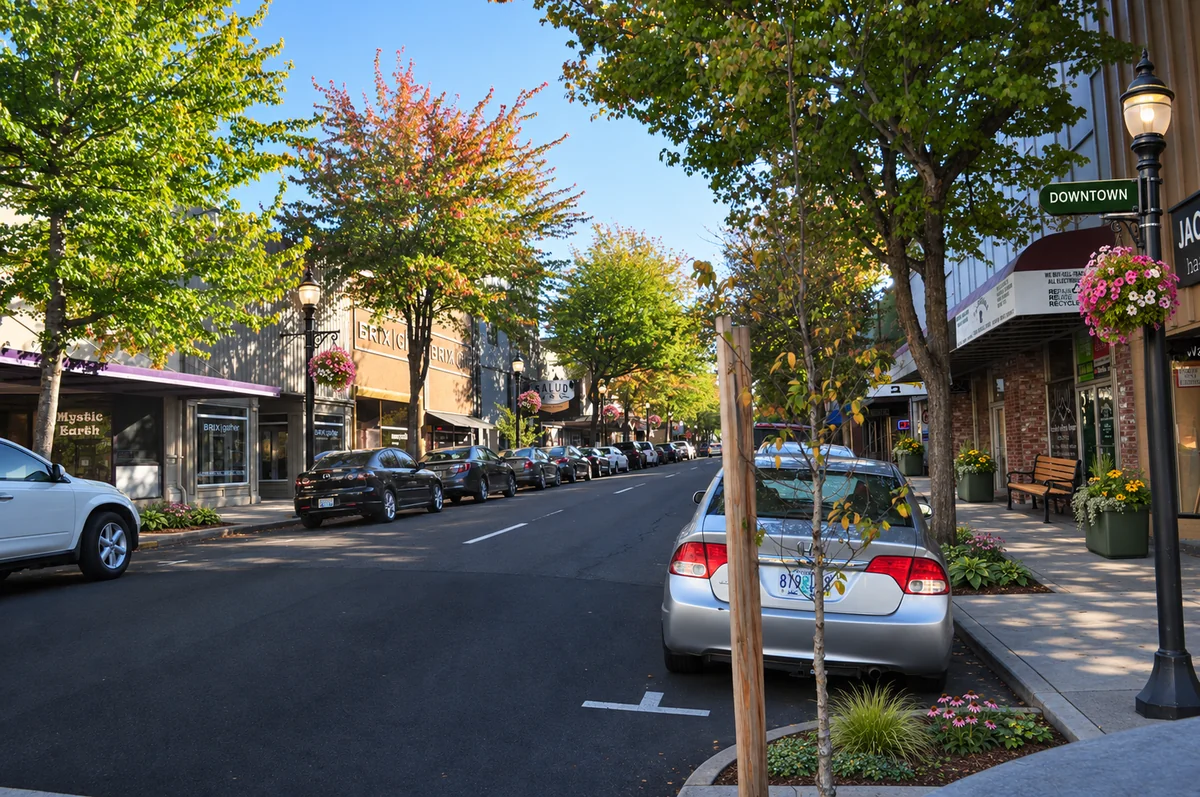
Clean windows, cared-for façades, legible signs and planting that survives the season. Public spaces should feel considered from one block to the next.
PLACE IDENTITY · A COMMUNITY PROPOSAL
A good town gives people reasons to arrive, stay awhile and come back. Roseburg can strengthen that experience through its streets, buildings, public spaces and everyday care—and make a clearer case for the families, businesses and investment it wants to attract.
 Illustrative AI concept
THE DIRECTION TO TEST
That should describe a normal afternoon here: a few useful stops, a meal, something for the kids and a comfortable walk between them.
The ambition is a place that works well for people who already live in the region, with an experience that gives visitors and prospective employers a reason to look again.
What would bring you back?WHAT TOWN BRANDING ACTUALLY INVOLVES
A name, a logo and a campaign can help people recognize a town. Their experience when they get there determines whether the message holds up.
Clean windows, cared-for façades, legible signs and planting that survives the season. Public spaces should feel considered from one block to the next.
A clear route from parking or transit to a shop, a comfortable crossing, somewhere to sit, and enough open places to make the trip worthwhile.
The Umpqua, the hills, historic buildings, public art, independent businesses and local makers. These give the place a character people can recognize and remember.
Someone responsible for watering, repairs, litter, lighting and worn signs. A beautiful opening day means little if nobody has agreed to maintain the work.
BUILD ON WHAT IS ALREADY HERE
Experience Roseburg promotes the area and maintains a downtown mural tour. Its mural project credits the City, property owners and the Historic Resource Review Commission for helping make the work possible. A useful identity effort would connect with that work and the businesses, artists and volunteers already investing in the town.
Two additions were completed on June 22, 2025: Notice Beauty, by Katie Daisy and Karen Eland at 506 SE Jackson Street, and The Watcher, by Brooks Engel at 808 SE Lane Avenue. These completed projects provide a starting point for a better connected downtown.
TWO REAL LOCATIONS · TWO ILLUSTRATIVE EDITS
These comparisons use actual Roseburg photographs from September 2016. They show the effect of coordinated signs, planting, seating and care while keeping the recognizable street and buildings.
REAL LOCATION · ILLUSTRATIVE CHANGES
Jackson Street in the Roseburg Downtown Historic District, Roseburg, Oregon
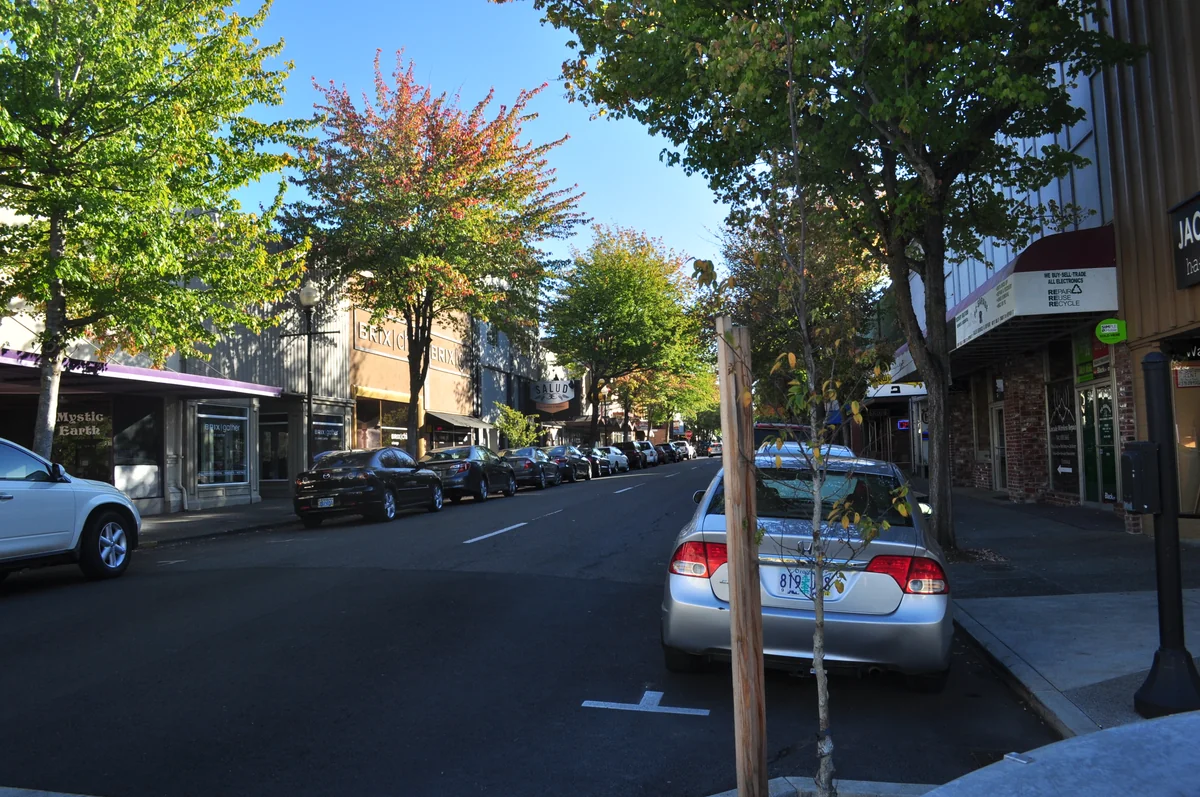
Use the slider, arrow keys or view buttons. The photograph records September 2016; it is not a survey of today’s conditions.
The concept repeats a small family of public details: dark-green signs, planting at tree bases, modest seating and pedestrian lighting. The buildings and individual shopfronts keep their own character.
Keep the walking route clear, protect street trees, preserve delivery access and choose planting that can be watered and maintained. A street image cannot establish lane operations or the correct location for a new fixture.
“Roseburg, Oregon - Jackson St. 01.jpg” by Joe Mabel, photographed September 28, 2016, CC BY-SA 4.0. View the source photograph
Concept edit by Greater Roseburg Tomorrow, based on a photograph by Joe Mabel. AI-assisted modifications. Licensed CC BY-SA 4.0. AI-assisted edit adding a coordinated sign and lamp details, flower baskets, tree-base planting, containers and seating; modest visual finish and exposure changes. Actual buildings and street layout retained as a visual reference. Website copies are resized and encoded as WebP.
Read the CC BY-SA 4.0 license . Credit the photographer and Greater Roseburg Tomorrow, link the source and license, and identify modifications when reusing the adapted image. The photographer does not endorse this proposal.
REAL LOCATION · ILLUSTRATIVE CHANGES
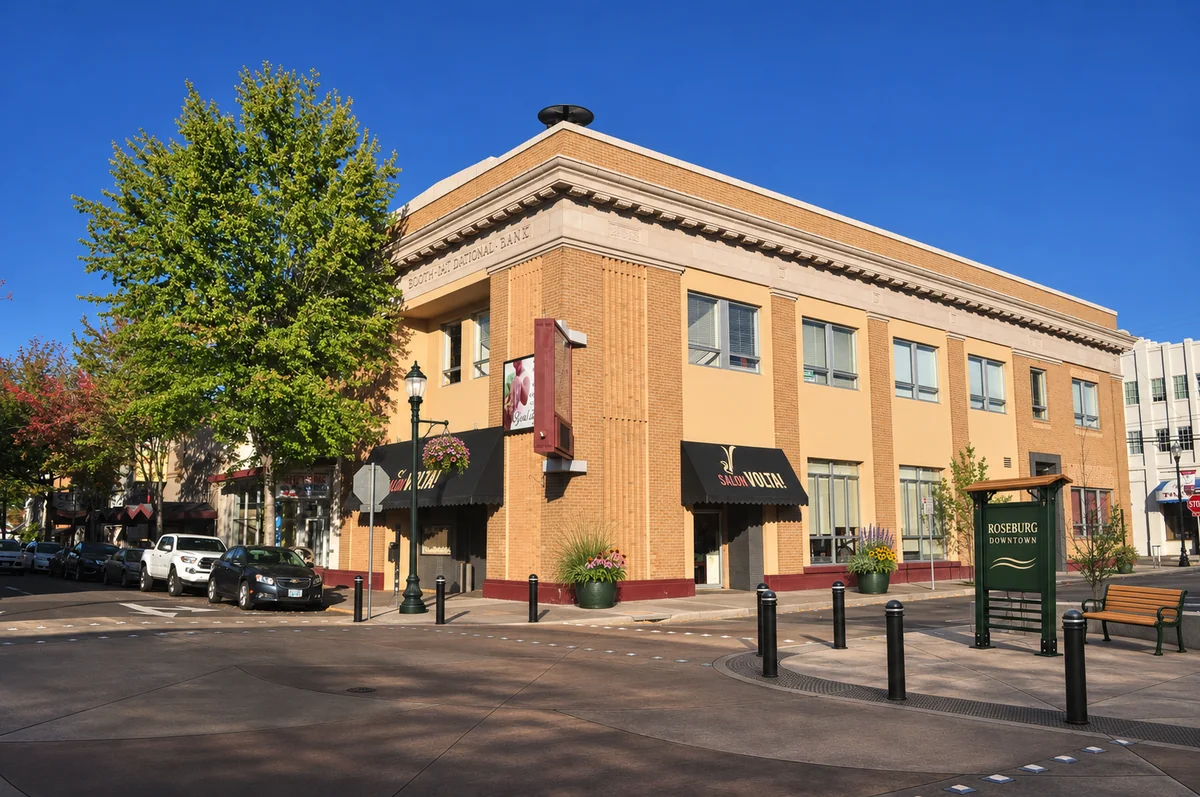
Former Booth/Douglas National Bank building, 567 Southeast Jackson Street, Roseburg, Oregon
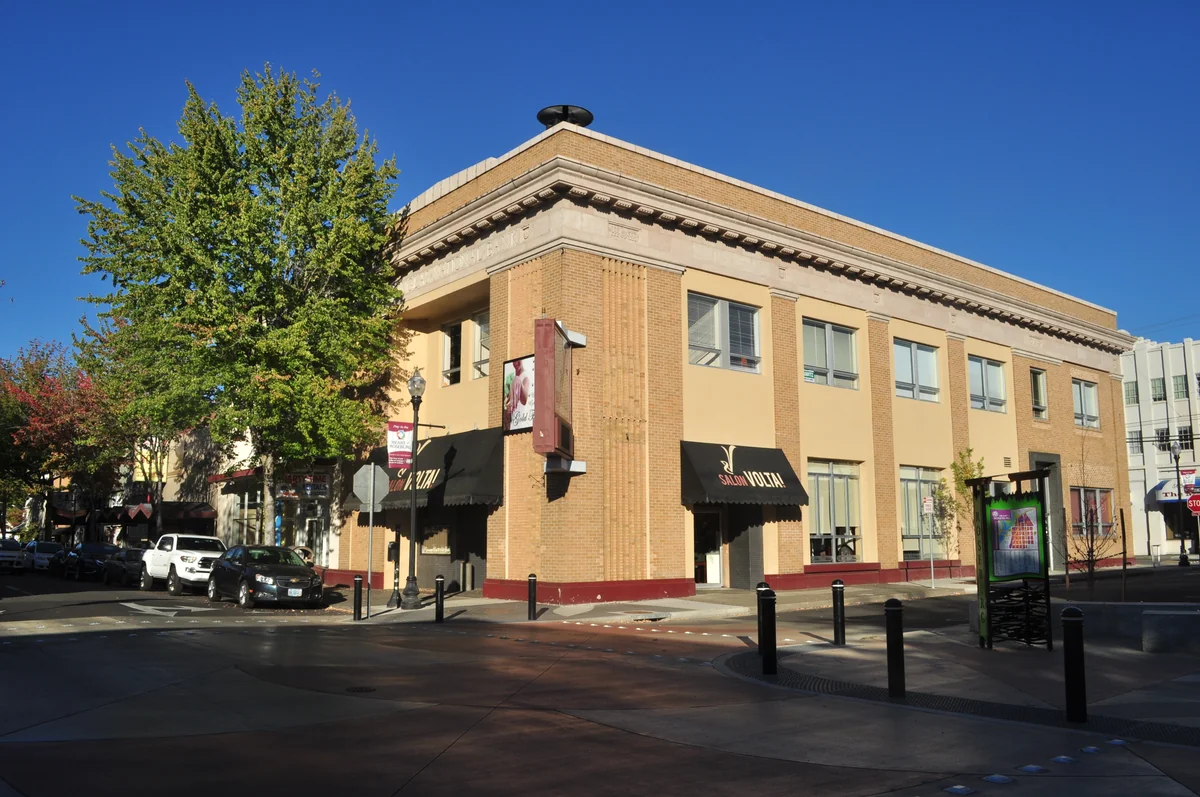
Use the slider, arrow keys or view buttons. The photograph records September 2016; it is not a survey of today’s conditions.
A coordinated information panel and a place to sit can make a small public space more useful. The concept keeps the building’s architecture and focuses attention on the pedestrian area around it.
Confirm ownership, maintenance access, clear routes through the corner and sightlines at the crossing. Agree on the information the sign should provide before approving its size and position.
“Roseburg, Oregon - former Douglas National Bank.jpg” by Joe Mabel, photographed September 28, 2016, CC BY-SA 4.0. View the source photograph
Concept edit by Greater Roseburg Tomorrow, based on a photograph by Joe Mabel. AI-assisted modifications. Licensed CC BY-SA 4.0. AI-assisted edit replacing the visible kiosk with coordinated Roseburg/Downtown signage, adding one bench and modest planting, and refreshing lamp/pavement/finish appearance. Actual building and intersection retained as a visual reference. Website copies are resized and encoded as WebP.
Read the CC BY-SA 4.0 license . Credit the photographer and Greater Roseburg Tomorrow, link the source and license, and identify modifications when reusing the adapted image. The photographer does not endorse this proposal.
These are proposals for discussion. Visible tenant signs belong to the 2016 source photographs and do not establish current occupancy or participation. Read all image credits and reuse terms
A SHARED VISUAL LANGUAGE
Public signs and furniture can belong to the same family while shops, restaurants, art and historic buildings remain distinctive. The purpose is to make a place easier to understand and more comfortable to use.
WORKING DESIGN SAMPLES · NOT AN OFFICIAL IDENTITY
Sample typography, color and material direction. This is not a replacement city logo or a sign approved for a particular location.
Use readable type, strong contrast and a consistent hierarchy: where you are, where to go, and what you will find. Pair durable coated metal with timber or other locally appropriate materials where exposure and maintenance allow.
Test the signs in sun, shade and evening light. Keep route information accurate. Add distances or walking times only after the route has been checked, and do not rely on a color alone to communicate a destination.
A bakery, a bike shop and a historic storefront do not need matching façades. A shared public setting should support their individuality. Work with owners on upkeep, entrances and well-placed signs; preserve distinctive architecture and invite local artists into appropriate commissions.
Resolve street-level details before expanding to gateways or a regional sign system. A consistent way to find a maintained restroom is more useful than a new slogan with nowhere to sit.
Provide resting opportunities without narrowing the clear walking path. Review placement with people who will use them.
Choose appropriate species, irrigation and replacement responsibility before installing a planter or basket.
Have lighting checked for useful illumination, glare, neighboring properties, energy use and maintenance access.
A PRACTICAL FIRST STEP
Investigate a short Jackson–Main downtown route with willing owners and the City. Link destinations that already draw people, then improve the experience between them before attempting a citywide rollout.
Choose the final blocks after walking them and talking with owners. The route should connect real destinations, practical parking and transit connections, and a comfortable place to pause. Review crossings and visibility as part of that work.
Coordinate with existing businesses and events. Test a few dependable evening openings with willing operators, so someone arriving after work has a reason to stay. Keep the link to parks and trails in the wider plan, without implying that an unreviewed route is accessible or complete.
DAYS 1–30
Bring willing Jackson and Main Street owners, merchants, City staff and residents together for a daytime and evening walk. Include people using wheelchairs, mobility aids and strollers. Choose one manageable route between existing destinations and make a dated record of what works and what gets in the way.
DAYS 31–60
Test sign sizes and locations on site. Have the responsible staff and professionals review clear walking space, crossings, curb ramps, visibility, deliveries and emergency access. Obtain permissions, historic review where applicable, quotes and a funded maintenance agreement.
DAYS 61–90
Install only the work that has permission and funding. Pair the route with an existing event or a voluntary evening-opening trial, then observe ordinary days as well. Record obstacles, make small corrections and publish what was learned before proposing a larger rollout.
MAKE THE WORK LAST
An identity effort needs a working agreement. Each participant should know what they can decide, what they are paying for and what they will maintain after the first event.
MEASURE THE EXPERIENCE
Record a baseline before installation. Repeat observations at the same locations and comparable times, noting weather, events and other changes that could affect results.
Publish the method and the limits alongside results. A busier event day does not establish lasting growth, and a refreshed street image does not prove a financial return. Use the evidence to decide what deserves another investment.
FOR DEVELOPERS AND BUSINESS OWNERS
A clear design direction, maintained public spaces and a dependable process give a prospective operator something concrete to evaluate. Pair that work with current property information, utilities, realistic costs and a capable operator.
HELP SHAPE THE FIRST ROUTE
Tell us about your experience of Roseburg. Which details make you proud of the place? Where does a visit become difficult? What would give you a reason to return more often?
People in Green, Winchester, Sutherlin, Myrtle Creek, Drain, Yoncalla and other surrounding communities use the town too. Their experiences belong in this discussion.
This is voluntary community feedback, not a representative poll or an official City consultation. Responses can point to useful questions; they do not establish a mandate.
Local project sources reviewed November 10, 2026. The proposed identity, route, schedule and responsibilities above are Greater Roseburg Tomorrow discussion proposals. They are not adopted City policy.